Ready for Living Overview
Supporting success for later life.
Our vision is to create an age-friendly community in which our older people are valued, respected, and empowered to live fulfilling lives in a supportive and inclusive environment, so they can maintain their independence, self-esteem, and dignity as they age.
The Ready for Living strategy focuses on those living in the Gore District however, there is a wider community of interest who live outside of the Gore District boundary. The strategy aims to create an inclusive and supportive community for older people, prioritising their needs and preferences. With a higher median age than the national average and a projected increase in the older population, there is a pressing need to develop an age-friendly community that enables aging in place, maintains independence, and encourages engagement. The strategy’s priorities, based on insights from workshops and relevant information, address challenges such as healthcare access, social isolation, affordable housing, financial security, transportation, age discrimination, health issues, caregiver burden, digital divide, and support systems, focusing on housing, employment, volunteerism, health and wellbeing, information and communication, recreation and outdoors, mobility and accessibility, social change, and safety.

What would the picture of ageing in the community of Gore 20 years from now? Can we visualise it?
Let’s attempt to do so:
Health
- Local – majority of health services accessed locally through technology
- Cost-friendly – cost is a significantly reducing barrier to access to health
- Accessible – Awarua Whanau Services (Free nurse led clinics), or similar services
Mobility
- Independent – less reliance on own car/licence
- Cost-friendly – transport no barrier to being community-active
- Physical-friendly – footpaths, multi-level buildings etc fit for older people
Housing
- Living longer in own homes – enabling older people to live longer in their own homes rather than going to rest homes or retirement villages
- Range of living options – suiting different needs/desires/financial ability
- Smart houses – technology in homes suites to all ages and needs
Social Participation
- Focus – enablers of social participation are identified and utilised
- Work and volunteering – supported and encouraged
- Barriers identified and addressed e.g. Transport or lack thereof
Employment and Volunteerism
- Employers – age-friendly
- Paid and unpaid employment for older people – equally valued
- Training / retraining – accessible and encouraged regardless of age
- Technology – high level of enablement
Accessibility
- Information – ensuring information is readily available, including hardcopies at various places
- Access – buildings, services, retailers accessible and focussed on the importance of older people
eg advertising, physical accessibility - Accreditation – Age-friendly Business recognition register is developed
- Infrastructure – upgrade and maintain.
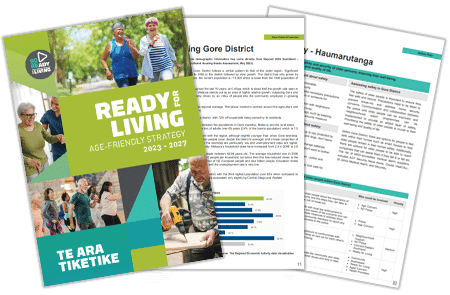
Ready for Living Age-friendly Strategy 2023 -2027
Discover more about our intergenerational Ready For Living project.